What Is Generative Engine Optimization (GEO)? The 2026 Guide
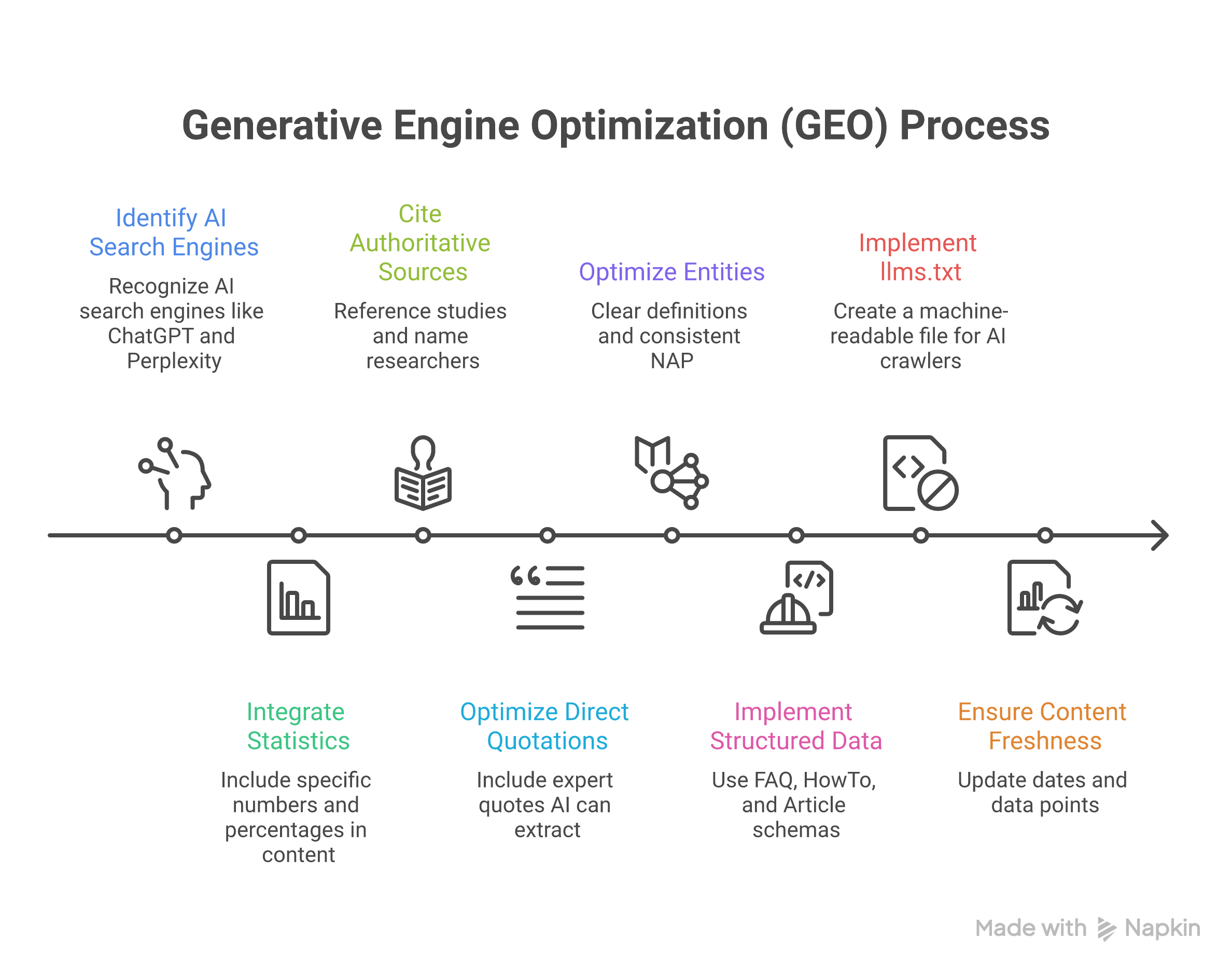
The way people find information online has fundamentally shifted. More than half of all product and service research now starts in an AI-powered interface -- ChatGPT, Perplexity, Google AI Overviews, Claude, or Gemini -- rather than a traditional search engine results page. When a business owner asks "best CRM for small teams" or a homeowner searches "how to fix a leaking faucet," the answer increasingly comes from an AI engine that synthesizes information from across the web and delivers a single, consolidated response.
Generative Engine Optimization (GEO) is the practice of structuring your content so these AI engines cite, reference, and recommend your brand. It is the natural evolution of SEO for an era where the search result is the answer, not a list of ten blue links.
For businesses in 2026, this is not optional. If your content is not structured for AI consumption, you are invisible to a growing segment of your potential customers -- the segment that never scrolls through Google results because an AI already gave them the answer.
This guide covers what GEO is, the research behind it, the specific strategies that work, and how to start implementing them today.
Last Updated: March 2026
What Is Generative Engine Optimization (GEO)?
Generative Engine Optimization is the process of optimizing your website content, structured data, and digital presence so that AI-powered search engines -- also called generative engines -- cite your brand when generating answers to user queries.
Traditional SEO focuses on ranking your pages higher on Google's search engine results pages (SERPs). GEO focuses on getting your information included in the AI-generated answer itself. The distinction matters: ranking #1 on Google means a user might click your link. Being cited by ChatGPT or Perplexity means the AI directly attributes information to your brand, often with a link, when answering a user's question.
The AI engines GEO targets include:
- ChatGPT (OpenAI) -- Used by over 200 million people weekly as of early 2026, with integrated web browsing and source citation
- Perplexity AI -- A search-first AI engine that cites sources for every claim and has grown to over 100 million monthly queries
- Google AI Overviews -- Google's AI-generated summaries that appear at the top of search results, now present on more than 40% of informational queries
- Claude (Anthropic) -- Increasingly used for research and analysis, with web search capabilities
- Gemini (Google) -- Integrated across Google's ecosystem, including search, workspace, and Android
The core difference between SEO and GEO comes down to this: SEO optimizes for algorithms that rank pages. GEO optimizes for large language models (LLMs) that synthesize and cite information. Both matter. But ignoring GEO in 2026 is like ignoring mobile optimization in 2015 -- you can do it, but you'll lose ground every month.
Why GEO Matters: The Data
The case for GEO is not theoretical. Peer-reviewed research and industry data back it up.
In 2024, researchers from Princeton University and Georgia Tech published "GEO: Generative Engine Optimization," the first rigorous academic study on optimizing content for AI-generated responses. The study tested nine different optimization strategies across thousands of queries and measured how each affected a website's visibility in AI-generated answers.
Key findings from the Princeton GEO research:
- Content optimized with specific statistics saw a 40% increase in citation visibility within AI-generated responses
- Adding authoritative source citations improved visibility by 37%
- Including direct quotations from experts boosted visibility by 30%
- These improvements were consistent across different generative engines and query types
The broader industry trends reinforce why this matters now:
- Gartner predicted that traditional search engine traffic would drop by 25% by 2026 as AI-powered search alternatives gained market share. That prediction is tracking accurately.
- Zero-click searches -- queries where the user gets their answer without clicking any result -- now represent over 65% of all Google searches, according to SparkToro and Datos research. AI Overviews accelerate this trend.
- Forrester Research estimates that by the end of 2026, 30% of all web traffic previously driven by organic search will shift to AI-mediated discovery channels.
The businesses that appear in AI-generated answers capture attention, trust, and traffic. The businesses that don't are losing market share to competitors who do -- and many don't even realize it because traditional analytics tools don't track AI citations effectively yet.
Traditional SEO vs GEO: Key Differences
SEO and GEO are complementary, not competing. Strong SEO remains the foundation. But the tactics, metrics, and priorities diverge in important ways.
| Dimension | Traditional SEO | GEO | |-----------|----------------|-----| | Target | Google SERPs | AI-generated answers | | Success metric | Rankings, clicks | Citations, mentions | | Content format | Keyword-optimized pages | Structured, citable facts | | Technical focus | Core Web Vitals, crawlability | Schema, entity clarity, llms.txt | | Link signals | Backlinks | Source authority + freshness | | Update cycle | Months | Days (AI re-indexes faster) |
The critical shift: In traditional SEO, you optimize a page to rank for a keyword. In GEO, you optimize individual facts, statistics, and claims within your content so that an AI engine can extract and cite them. A single well-structured paragraph with a clear statistic and named source can generate more AI visibility than an entire page optimized for a keyword.
This means content strategy changes. Instead of writing 2,000-word posts packed with keyword variations, GEO rewards content that contains discrete, verifiable, clearly attributed facts that an LLM can confidently cite. Both approaches can coexist in the same piece of content -- but only if you intentionally structure for both.
Another key difference: speed of impact. Traditional SEO changes can take weeks or months to affect rankings as Google recrawls and reevaluates pages. AI engines re-index and re-synthesize sources much faster. Updated content with fresh data points can appear in AI-generated answers within days.
The 7 GEO Strategies That Work in 2026
These strategies are drawn from the Princeton GEO research, real-world testing, and patterns observed across AI engine behavior. They are ordered by measured impact.
1. Statistic Integration
Adding specific numbers, percentages, dollar amounts, and quantifiable data points to your content is the single most effective GEO strategy. The Princeton study found that statistic-enriched content saw a 40% increase in visibility within AI-generated answers.
AI engines prioritize citable facts. A sentence like "Our clients see significant improvements in conversion rates" is uncitable. A sentence like "Webaholics clients saw an average 34% improvement in conversion rates within 90 days of site redesign" gives the AI something concrete to reference.
How to implement:
- Add specific numbers to every major claim on your site
- Include timeframes ("in Q1 2026," "within 90 days," "over a 12-month period")
- Use dollar amounts, percentages, and ratios rather than vague qualifiers
- Cite the source of each statistic, even if the source is your own internal data
2. Authoritative Source Citations
Referencing credible studies, naming specific researchers, and linking to primary sources improved AI citation visibility by 37% in the Princeton study. AI engines are trained to prioritize information that comes from or references authoritative sources.
How to implement:
- Reference peer-reviewed studies by name (e.g., "according to the 2024 Princeton GEO study by Aggarwal et al.")
- Link to primary sources, not secondary summaries
- Cite industry reports from recognized firms (Gartner, Forrester, McKinsey, HubSpot)
- Name specific researchers, authors, and institutions rather than saying "studies show"
3. Direct Quotation Optimization
Including expert quotes that AI engines can directly extract increased visibility by 30%. LLMs treat quoted material as higher-confidence information because it is attributed to a specific person.
How to implement:
- Include direct quotes from your CEO, subject matter experts, or industry leaders
- Format quotes clearly with attribution: "According to [Name], [Title] at [Company]..."
- Use quotes to reinforce key claims with expert authority
- Make sure the quoted person is a real, verifiable individual with a public presence
4. Entity Optimization
AI engines build knowledge graphs -- structured networks of entities (people, places, companies, products) and the relationships between them. Clear, unambiguous entity definitions help AI engines understand what your brand is and what it does.
How to implement:
- Define your brand clearly on your homepage and About page: what you do, where you operate, who you serve
- Use consistent naming across all platforms (your Google Business Profile name should match your website, social profiles, and directory listings exactly)
- Maintain consistent NAP (Name, Address, Phone) data everywhere your business appears online
- Create dedicated pages for each service you offer with clear definitions
For local businesses, entity optimization is especially powerful. Webaholics' AI marketing services include full entity audits to ensure AI engines can accurately represent your brand.
5. Structured Data and Schema Markup
Schema markup provides AI engines with machine-readable context about your content. While traditional SEO uses schema for rich snippets, GEO uses it to feed AI knowledge graphs directly.
Priority schemas for GEO:
- FAQPage -- Structures questions and answers that AI engines can directly extract
- HowTo -- Provides step-by-step instructions in a format LLMs can synthesize
- Article -- Identifies author, publication date, and topic for content attribution
- LocalBusiness -- Feeds business details (hours, location, services) into AI knowledge bases
- Organization -- Establishes entity relationships and brand details
Structured data does not guarantee AI citation, but it significantly increases the likelihood that AI engines correctly understand and attribute your content. Our SEO services team implements comprehensive schema strategies for every client.
6. llms.txt Implementation
llms.txt is a machine-readable file placed at your domain root (similar to robots.txt) that tells AI crawlers what your site is about, what content is most important, and how to categorize your information. It is an emerging standard gaining adoption across the industry.
What llms.txt typically contains:
- A brief description of your organization
- Your primary services or products
- Key facts and statistics about your business
- Links to your most important content
- Contact information and service areas
- Any content you want AI engines to prioritize or deprioritize
Think of it as a cover letter for AI crawlers. While robots.txt tells search engines what not to crawl, llms.txt tells AI engines what to prioritize. Implementation is straightforward -- it is a plain text or markdown file -- and the potential upside is significant as AI crawlers increasingly look for this signal.
7. Content Freshness and Recency Signals
AI engines heavily weight recency. Outdated content gets deprioritized. Fresh content with current data points, recent references, and clear "Last Updated" dates gets preferred.
How to implement:
- Add visible "Last Updated" dates to all major content pages
- Update statistics annually at minimum -- replace 2024 data with 2025 or 2026 figures
- Reference current events, recent studies, and timely industry developments
- Refresh cornerstone content quarterly with new data points
- Use ISO 8601 date format in your Article schema (AI engines parse this reliably)
Content freshness is one of the easiest GEO wins. A 30-minute update to a high-performing blog post -- adding two new statistics, updating the "Last Updated" date, and refreshing one source citation -- can meaningfully improve its AI citation potential.
How to Check If AI Engines Cite Your Brand
Before you optimize, you need a baseline. The most reliable method in 2026 is still manual testing, because automated AI citation tracking tools remain immature.
Run an AI citation audit:
- Identify 5-10 queries your target customers would ask that relate to your products or services
- Enter each query into ChatGPT, Perplexity, Google AI Overviews, and Claude
- For each AI engine and each query, record whether your brand is:
- Cited (directly mentioned or linked)
- Paraphrased (information from your site is used but not attributed)
- Absent (not referenced at all)
- Note which competitors are being cited for queries where you are absent
- Repeat this audit monthly to track progress
What to look for: If competitors are consistently cited and you are absent, examine their content for the patterns described above -- statistics, source citations, schema markup, freshness signals. The gap between their content structure and yours is your GEO opportunity.
Automated monitoring tools are emerging, but as of March 2026, manual testing across multiple AI platforms remains the most accurate approach. Dedicate 30 minutes per month to this audit. The insights are worth the time.
GEO and Local Businesses
Local businesses stand to benefit disproportionately from GEO, for a simple reason: there is far less competition in AI answers for local queries than for national ones.
When someone asks an AI engine "best Italian restaurant in Salt Lake City" or "top web design agency in Utah," the AI pulls from a much smaller pool of sources than when answering "best CRM software." Local businesses that optimize for GEO early can dominate their market's AI-generated recommendations before competitors catch on.
Local GEO priorities:
- Google Business Profile optimization -- GBP data feeds directly into Google's AI knowledge graphs, which means your business hours, services, reviews, and photos appear in AI Overviews. Keep your GBP profile complete and current.
- Local schema markup -- Implement LocalBusiness schema with accurate address, phone, service areas, and business hours. This structured data is among the first things AI engines parse for local queries.
- NAP consistency -- Your business name, address, and phone number must be identical across your website, GBP, Yelp, industry directories, and social profiles. Inconsistencies confuse AI knowledge graphs and reduce citation confidence.
- Review signals -- AI engines reference review volume and sentiment when recommending local businesses. A steady stream of authentic reviews strengthens your position in AI-generated local recommendations.
Local businesses that combine these tactics with strong AI-optimized SEO create a competitive moat that is difficult for rivals to replicate quickly. The first mover advantage in local GEO is real and significant. Learn how Webaholics helps local businesses with AI marketing.
Getting Started with GEO
You do not need to implement everything at once. Here is a practical starting sequence:
Week 1: AI Citation Audit. Test your brand across ChatGPT, Perplexity, Google AI Overviews, and Claude using queries your customers actually ask. Document where you are cited, paraphrased, or absent. This baseline tells you where to focus.
Week 2: Schema and llms.txt. Implement or update your structured data (FAQPage, Article, LocalBusiness, Organization schemas). Create an llms.txt file at your domain root with a clear description of your business, services, and key content.
Week 3-4: Content Optimization. Start with your highest-traffic pages. Add specific statistics with sources. Include expert quotes. Update "Last Updated" dates. Ensure every major claim is backed by a named, linked source.
Ongoing: Monthly Monitoring. Repeat your AI citation audit monthly. Track which queries now return your brand. Refresh content quarterly with new data points and recent references.
GEO is not a one-time project. It is an ongoing practice, much like traditional SEO. But the businesses that start now will have a meaningful advantage over those that wait.
Ready to get your business cited by AI engines? Our AI SEO services team builds GEO strategies tailored to your industry and market. Contact us to start with an AI citation audit.
Frequently Asked Questions
What is the difference between SEO and GEO?
SEO (Search Engine Optimization) focuses on ranking your website higher on traditional search engine results pages like Google. GEO (Generative Engine Optimization) focuses on getting your content cited by AI-powered answer engines like ChatGPT, Perplexity, Google AI Overviews, and Claude. SEO targets clicks from search rankings. GEO targets citations within AI-generated answers. Both are important, and strong SEO provides a foundation for effective GEO.
Does GEO replace traditional SEO?
No. GEO complements traditional SEO -- it does not replace it. Google still processes over 8.5 billion searches per day, and organic search traffic remains critical for most businesses. However, the share of queries answered by AI is growing rapidly. Businesses need both SEO and GEO working together. Think of GEO as the next layer on top of your existing SEO foundation.
How long does GEO take to show results?
GEO improvements can appear faster than traditional SEO changes. Because AI engines re-index and re-synthesize sources more frequently than Google updates its rankings, optimized content can begin appearing in AI-generated answers within 1-4 weeks of implementation. However, building consistent AI citation visibility across multiple engines and query types typically takes 2-4 months of sustained optimization effort.
Can small businesses benefit from GEO?
Yes -- and in many cases, small businesses benefit more than large enterprises. For local and niche queries, AI engines draw from a smaller pool of sources, which means less competition for citations. A local accounting firm in Salt Lake City that implements GEO strategies will face far fewer competitors in AI answers than a national software company. The Princeton research showed that GEO improvements were especially pronounced for smaller, less-established websites.
What is llms.txt?
llms.txt is a plain text or markdown file placed at the root of your website (e.g., yourdomain.com/llms.txt) that provides AI crawlers with a structured summary of your site's purpose, key content, and important information. It functions similarly to robots.txt but is designed specifically for large language model crawlers rather than traditional search engine bots. It tells AI engines what your business does, what content is most authoritative, and how to categorize your information. Adoption is growing across the industry as businesses recognize the need to communicate directly with AI systems.
How much does GEO cost?
GEO costs vary based on scope. Basic implementations -- schema markup, llms.txt, content updates with statistics and citations -- can be handled by an experienced SEO team as part of ongoing optimization work, typically ranging from $1,500 to $5,000 per month depending on the volume of content and technical complexity. Enterprise-level GEO programs with custom AI monitoring, large-scale content restructuring, and competitive analysis run higher. The ROI is strong: businesses cited in AI-generated answers report increased brand visibility, higher trust signals, and incremental traffic that traditional SEO alone does not capture. Contact our team for a customized assessment.
Related Resources
- AI SEO Services -- Comprehensive AI search optimization, including GEO strategy, schema implementation, and AI citation monitoring.
- AI Marketing Agency - Salt Lake City -- Full-service AI-powered marketing for businesses that want to lead, not follow.
- SEO Services -- Traditional and AI-optimized SEO to drive organic traffic and AI citations.
- Contact Us -- Start with a free AI citation audit to see where your brand stands in AI-generated answers.